Meet Tauros
Few Pokémon capture the spirit of the open road quite like Tauros. This Normal-type bull Pokémon has been stomping through the tall grass since the very first generation, and its blend of raw power and restless energy has kept it relevant for decades.
What Kind of Pokémon Is Tauros?
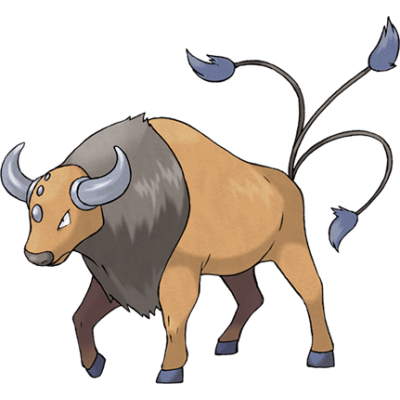
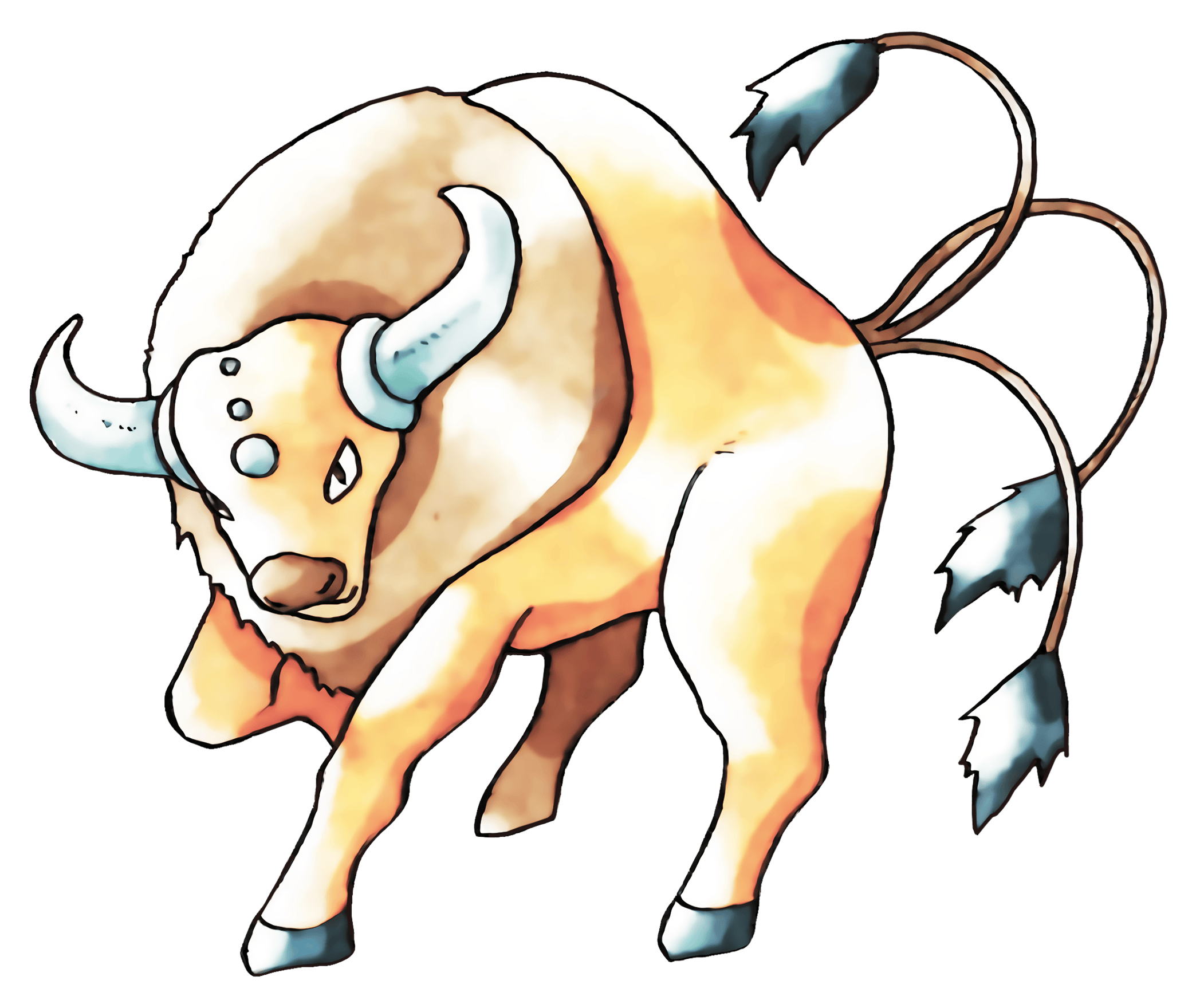
Tauros is a pure Normal-type introduced in Generation I as part of the original 151. It stands out for its muscular, bovine build, with a dark brown mane framing three prominent horns on its head and three more ridges along its back. Its most defining trait, though, is its temperament: Tauros is famously hot-blooded and loves nothing more than charging at full speed.
Tauros in the Games
In the games, Tauros earned a reputation early on as a fast, hard-hitting physical attacker. Its signature move, Take Down, and later additions like Thrash and Double-Edge, made it a genuine threat in competitive play during the early generations. Catching one is a challenge in itself — in the original games, it roams the Safari Zone and tends to flee before you can reel it in. Over the years, Tauros has also picked up regional and Paldean forms, giving longtime fans new spins on an old favorite.
Tauros in the Anime
On screen, Tauros is best remembered as one of Ash's own Pokémon. In the original series, he accidentally caught a whole herd of them in the Safari Zone, and they became a recurring fixture at Professor Oak's lab. They also appear in Tauros-themed races and stampedes, showing off the sheer speed and stubbornness that define the species.
Abilities and Battle Strengths
Tauros has long been a staple of competitive Pokémon, prized for its blistering Speed and respectable Attack. With a base Speed of 110, it outspeeds much of the unboosted metagame, letting it strike first with powerful Normal-type moves and coverage options alike.
Abilities
Tauros has access to three abilities, two of which define its role.
- Intimidate lowers the foe's Attack on switch-in, softening physical attackers and giving Tauros more opportunities to come in safely. It is the preferred choice in most formats.
- Anger Point maximizes Attack when Tauros is hit by a critical hit, but the effect is unreliable because it depends on the opponent's luck.
- Sheer Force (available only in some contexts or via certain mechanics) boosts moves with secondary effects, though Tauros's movepool rarely capitalizes on it.
Strengths
Tauros hits hard and fast, and its movepool gives it tools to break through common checks.
- High Speed lets it revenge kill weakened threats and pressure slower walls.
- Strong STAB in Body Slam or Double-Edge deals heavy neutral damage, with Body Slam offering a paralysis chance.
- Coverage moves like Earthquake, Rock Slide, and Zen Headbutt let it hit Rock, Steel, and Fighting types that resist Normal.
- Intimidate provides defensive utility, making it easier to switch in against physical attackers.
- Access to Work Up or Bulk Up (depending on generation) can turn it into a late-game sweeper.
Weaknesses
Its Normal typing and frailty hold it back against certain archetypes.
- A single Fighting-type weakness means common Close Combat and Mach Punch users threaten it badly.
- Ghost types are fully immune to its STAB, forcing reliance on coverage.
- Mediocre defenses mean it cannot take many neutral hits, especially special attacks.
- It is vulnerable to priority moves, status such as burn, and residual damage from entry hazards.
- No reliable recovery limits its longevity across a match.
Tips for trainers
Getting the most from Tauros means playing to its speed and picking your spots carefully.
- Run maximum Speed investment and a Jolly nature to outspeed key threats like Gengar and Starmie.
- Pair it with a teammate that removes Ghost and Fighting types, such as a Dark- or Psychic-type.
- Use Intimidate pivots to bring Tauros in on physical attackers, then fire off a strong STAB or coverage move.
- Keep hazards off your side so Tauros can switch in repeatedly without losing health.
- Save it for the late game once opposing walls and priority users are weakened, then clean up with its Speed advantage.
- Consider a Choice Band or Life Orb set for immediate power, or a boosting set if you can create a free turn.


Evolution and Where to Find It
Tauros does not evolve. It is a single-stage Pokémon with no pre-evolution and no evolution, introduced in Generation I as part of the original 151. No item, level, trade, or condition will change it into another species, and no species evolves into Tauros.
That lack of an evolution line is unusual for a Normal-type from Generation I, since contemporaries like Meowth, Growlithe, and Eevee all have branching or linear families. Tauros instead has always been a standalone encounter, typically found in open grassland or safari-style areas rather than raised from a weaker form.
The closest thing to a related form is Paldean Tauros, introduced in Generation IX. This is a regional form, not an evolution: it has Combat, Blaze, and Aqua breeds, each a distinct Fire- or Water- or Fighting-flavored variant. It still does not evolve, and breeding Paldean Tauros produces Paldean Tauros rather than the Kantonian original.
How to obtain Tauros in the main games
- Red, Blue, Yellow: Catch it in the Safari Zone. It is rare, appears in the tall grass areas, and often flees, so bring plenty of Safari Balls.
- Gold, Silver, Crystal: Found on Routes 38 and 39 in Johto, in the grass, as a rare encounter.
- Ruby, Sapphire, Emerald, FireRed, LeafGreen: In FireRed and LeafGreen it returns to the Safari Zone. In Hoenn it is not catchable in the wild and must be traded forward from earlier games.
- Diamond, Pearl, Platinum, HeartGold, SoulSilver: Available via the Poké Radar on Route 209 and Route 210 in Sinnoh, and in the Johto Safari Zone in HeartGold and SoulSilver.
- Black, White, Black 2, White 2: Not in the regional dex; obtain it through transfer from Generation IV or through in-game trades and events.
- X, Y, Omega Ruby, Alpha Sapphire: Found in the Friend Safari in X and Y, and on Routes 112 and 113 in Hoenn.
- Sun, Moon, Ultra Sun, Ultra Moon: Available through the Island Scan in Alola on specific days.
- Sword, Shield: Appears in the Wild Area and on the Isle of Armor, including in Max Raid Battles.
- Scarlet, Violet: Kantonian Tauros is not native to Paldea; the region instead has Paldean Tauros, which can be caught in the wild across the Paldean map.
If you specifically want the classic Kantonian Tauros in a modern game, the most reliable routes are trading from an older save, using Pokémon HOME to transfer one forward, or hunting it in the Wild Area in Sword and Shield.
Fun Trivia
Tauros Facts
-
Tauros was one of the original 151 Pokémon introduced in Generation I, debuting in the 1996 Japanese releases of Pokémon Red and Green. In those games, it could only be found in the Safari Zone, making it one of several rare creatures tied to that special area.
-
Its name comes from the Greek word "tauros," meaning bull, which also gives us the word "taurus." The constellation Taurus represents a bull, tying the Pokémon directly to real-world mythology and astronomy.
-
Tauros has a base Speed stat of 110, making it unusually fast for a Normal-type. This speed, combined with its Attack stat of 100, helped it become a dominant competitive threat in the early days of the franchise, especially with moves like Hyper Beam and Body Slam.
-
In the Pokémon anime, Ash Ketchum famously caught a herd of thirty Tauros in the Safari Zone episode, a reference to the games' difficulty in catching the Pokémon. Ash rarely used them in battle, but they became a running joke among fans.
-
Despite its bull-like appearance, Tauros is a pure Normal-type with no secondary typing, and it has never received a Mega Evolution or regional form, unlike many of its Generation I contemporaries such as Kangaskhan or the Kanto starters.
You Might Also Like: 7 Things Every Fan Should Know About Blaziken 20
Which Pokemon should we cover next? Tell us your favorite in the comments!